
Category Archives: Disaster Resilience

Federal “Reinsurance” Proposal Raises Red Flags

By Sean Kevelighan, Triple-I CEO

Legislation proposed by U.S. Rep. Adam Schiff (D-Calif.) to create a federal “catastrophe reinsurance program” raises several concerns that warrant scrutiny and discussion – starting with the question: Does what’s being proposed even qualify as insurance?

If enacted into law, the bill would establish a “catastrophic property loss reinsurance program…to provide reinsurance for qualifying primary insurance companies.” To qualify, insurers would have to offer:

  • An all-perils property insurance policy for residential and commercial property, and
  • A loss-prevention partnership with the policyholder to encourage investments and activities that reduce insured and economic losses from a catastrophe peril.

The proposed program would phase in coverage requirements peril by peril over several years and discontinue FEMA’s National Flood Insurance Program (NFIP). It would set coverage thresholds and dictate rating factors based on input from a board in which the insurance industry is only nominally represented.

And nowhere in the 22-page proposal do any of the following words or phrases appear:

  1. “Actuarial soundness”;
  2. “Risk-based pricing”;
  3. “Reserves”; or
  4. “Policyholder surplus”.

Actuarially sound risk-based pricing and the need to maintain adequate reserves and policyholder surplus to ensure financial strength and claims-paying ability are the bedrock of any insurance program worthy of the name – not technical fine print to be worked out down the road while existing mechanisms are being dismantled and market forces distorted through government involvement.

Insurance is a complicated discipline, and prior federal attempts at providing coverage have struggled to balance their goal of increasing availability and reducing premiums against the need to base underwriting and pricing on actuarially sound principles to ensure sufficient reserves for paying claims.

Actuarially sound risk-based pricing and the need to maintain adequate reserves and policyholder surplus…are the bedrock of any insurance program worthy of the name – not technical fine print to be worked out down the road

Sean Kevelighan, CEO, Triple-I

Learn from history

NFIP is a strong case in point. Created in 1968 to protect property owners for a peril that most private insurers were reluctant to cover, NFIP’s “one-size-fits-all” approach to underwriting and pricing has led to the program now owing more than $20 billion to the U.S. Treasury because it lacked the reserves to fully pay claims after major events like Hurricane Katrina and Superstorm Sandy. It also often led to lower-risk property owners unfairly subsidizing coverage for higher-risk properties.

Having thus learned the importance of risk-based pricing, NFIP has changed its underwriting and pricing methodology. The new approach – Risk Rating 2.0, announced in 2019 and fully implemented as of April 1, 2023 – more equitably distributes premiums based on home value and individual properties’ flood risk. As a result, premiums of previously subsidized policyholders – particularly in coastal areas with higher values – have risen, leading to outcries from many higher-risk owners who have seen their subsidies reduced.

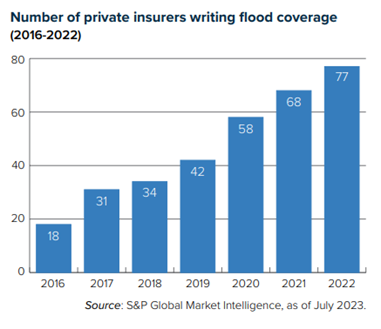
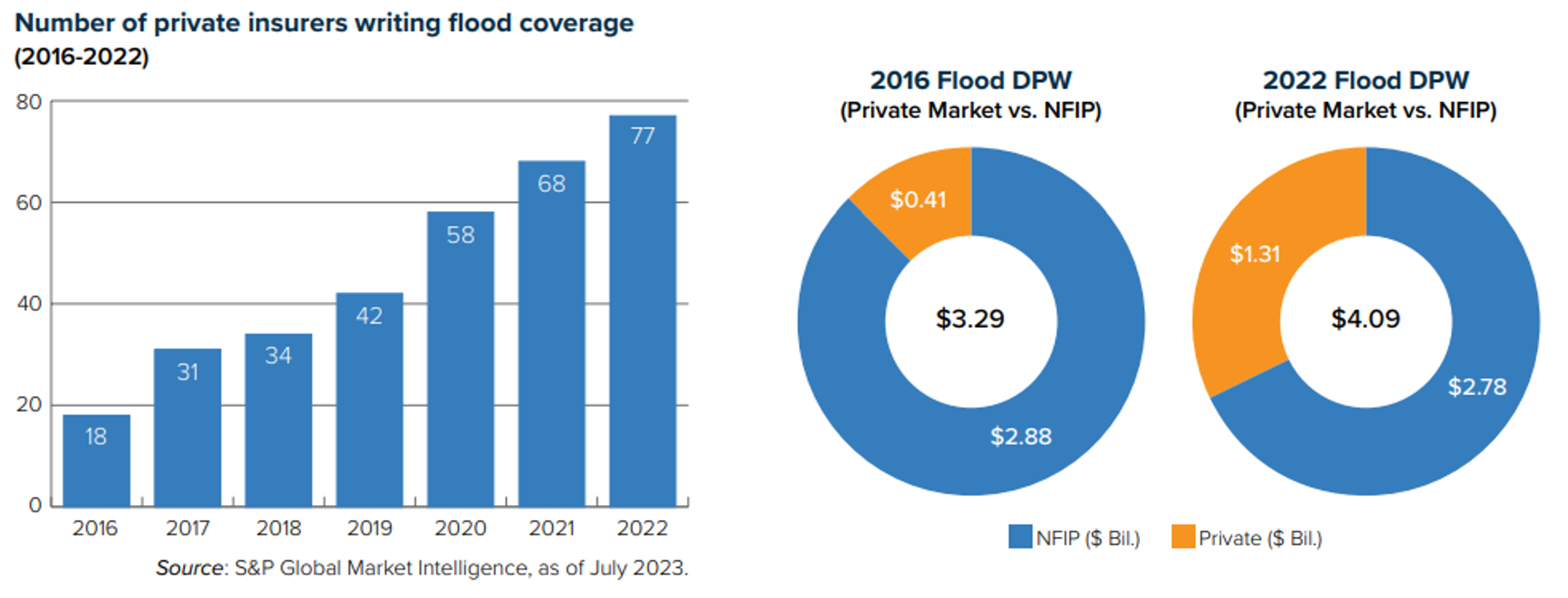
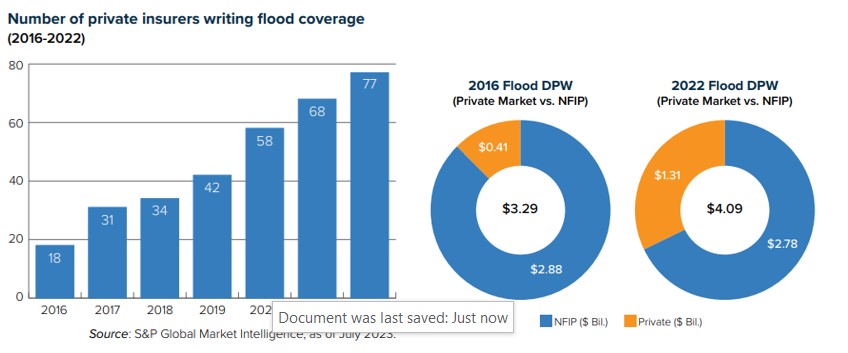
In addition to leading to fairer pricing, Risk Rating 2.0 – by reducing market distortions – increases incentives for private insurers to get involved. For a long time, private insurers considered flood an untouchable peril, but improved data modeling and analytical tools have increased their comfort writing this business. As the charts below show, private insurers have been playing a steadily increasing role in recent years, covering a larger percentage of a growing risk pool.

Over time, this trend should lead to greater availability and affordability of flood insurance coverage.

Rather than incorporating the lessons generated by NFIP’s experience with a single peril, Rep. Schiff’s proposal would discontinue the reformed flood insurance program while adding a new layer of complexity to coverage across all perils and casting into question the future of various state insurance programs and residual market mechanisms currently in place.

Time-tested principles

Any attempt by the federal government to address insurance availability and affordability concerns must be made with an understanding of how insurance works – from pricing and underwriting to reserving and claim settlement. For example, the Schiff bill proposes piloting an all-perils policy with a term of five years. There are good reasons for property/casualty policies to be written with a one-year term. Specifically, the conditions that affect claims costs can change quickly, and insurers – as referenced above – must set aside sufficient reserves to be able to pay all legitimate claims. If they cannot revisit pricing annually, the financial results could be disastrous.

“Who would have thought in 2019 that replacement costs would increase 55 percent within three years?” asked Dale Porfilio, Triple-I’s chief insurance officer. Supply-chain disruptions related to the COVID-19 pandemic and Russia’s invasion of Ukraine contributed to just such a replacement-cost spike. “Requiring five-year terms for policies would have led to a massive drain on policyholder surplus.” 

Policyholder surplus is the financial cushion representing the difference between an insurer’s assets and its liabilities.

In announcing his proposed legislation, Rep. Schiff said it is intended to “insulate consumers from unrestrained cost increases by offering insurers a transparent, fairly priced public reinsurance alternative for the worst climate-driven catastrophes.”

This language ignores the fact that, under state-by-state regulation, premium rate increases are anything but “unrestrained” and ratemaking is based on actuarially sound principles that are transparent and fair. Property/casualty insurance already is one of the most heavily regulated industries in the United States.

Consumers deserve real solutions

Policyholders have legitimate concerns about affordability and, in some cases, availability of insurance. These concerns can create pressure for political leaders at both the state and federal levels to advance measures that are perceived as promising to help. Unfortunately, many recent proposals begin by mischaracterizing current trends as an “insurance crisis,” as opposed to what they really represent: A risk crisis.

Insurance premium rates tend to move in line with the frequency and severity of the perils they cover. They also are affected by factors like fraud and litigation abuse; climate, population, and development trends; and global economics and geopolitics. That is why insurers hire actuaries and data scientists and employ cutting-edge modeling technology to ensure that insurance pricing is actuarially sound, fair, and compliant with regulatory requirements in all states in which they do business.

That is how insurers keep lower-risk policyholders from unfairly subsidizing higher-risk ones.

To its credit, the federal government is working to reduce climate-related risks and investing in resilience through programs like Community Disaster Resilience Zones (CDRZ) and FEMA’s Building Resilient Infrastructure and Communities (BRIC) program. The Bipartisan Infrastructure Law contains substantial funding to promote climate resilience. These are worthy endeavors aimed at addressing risks that drive up insurance costs.

But history has shown that direct government involvement in the underwriting and pricing of insurance products tends not to end well.  Any plan that would attempt to micromanage insurers’ coverage of all perils through a lens that ignores time-tested, actuarially sound risk-based pricing principles raises a host of red flags that must be discussed and addressed before such a plan is allowed to become law.

Learn More:

It’s Not an “Insurance Crisis” — It’s a Risk Crisis

Miami-Dade, Fla., Sees Flood Insurance Rate Cuts, Thanks to Resilience Investment

Illinois Bill Highlights Need for Education on Risk-Based Pricing of Insurance

Education Can Overcome Doubts on Credit-Based Insurance Scores, IRC Survey Suggests

Matching Price to Peril Helps Keep Insurance Available and Affordable

Policyholder Surplus Matters: Here’s Why

Triple-I Issues Brief: Flood

Triple-I Issues Brief: Proposition 103 and California’s Risk Crisis

Triple-I Issues Brief: Risk-based Pricing of Insurance

Triple-I Issues Brief: How Inflation Affects P/C Insurance Pricing – and How It Doesn’t

Triple-I Issues Brief: Race and Insurance Pricing

Despite High-Profile Events, U.S. Wildfire Severity, Frequency
Have Been Declining

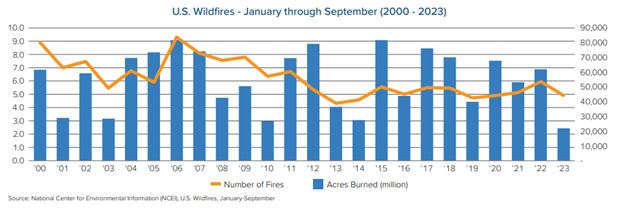
With record-breaking wildfires making headlines in recent years, it may be surprising to learn that U.S. wildfire frequency and severity for in 2023 are on track to be the lowest in the past two decades. In fact, the trend has been generally downward since 2000, according to a recently published Triple-I Issues Brief.

Despite catastrophic losses in Washington State, Hawaii, Louisiana, and elsewhere, California – a state often considered synonymous with wildfire – is in the midst of its second mild fire season in a row. This may be due to drought-breaking rains and snows, but Texas is experiencing fewer wildfires than in 2022, despite worsening drought conditions. About 37 percent of the continental U.S. remains under some form of drought, according to the U.S. Drought Monitor.

At the same time, Swiss Re reports that wildfire’s share of insured natural catastrophe losses has doubled over the past 30 years. How can those trends be reconciled? At least part of the answer resides in population trends – specifically, growing numbers of people choosing to live in the wildland-urban interface (WUI), the zone between unoccupied and developed land, where structures and human activity intermingle with vegetative fuels.

 Mitigation is necessary – but not sufficient

The improvements in frequency and severity are likely due to investments in mitigation. State and local authorities have invested heavily to mitigate the human causes of wildfire. In addition, the federal Infrastructure and Jobs Act of 2021 included billions to support wildfire-risk reduction, homeowner investment in mitigation, and improved responsiveness to fires. More recently, the Biden Administration announced $185 million for wildfire mitigation and resilience as part of the Investing in America Agenda, which should help continue the declines in frequency and severity.

But with more people living in the WUI – nearly 99 million, or one third of the U.S. population, according to the U.S. Fire Administration – more than 46 million homes with an estimated value of $1.3 trillion are at risk.

According to the 2022 Annual Report of Wildfires produced by the National Interagency Fire Center (NIFC), 68,988 wildfires were reported and 7.5 million acres burned in 2022.  Of these fires, 89 percent were caused by human activity and burned 55 acres per fire. By contrast, the 11 percent of fires caused by lightning resulted in an average of 563 acres burned, 10 times more than human-caused fires.

This difference may shed light on why the number of fires has been decreasing more dramatically than acres burned. Further, population shifts into the WUI are increasing the proximity of property to places prone to fire, helping to explain the rise in wildfire’s increased percentage of insured losses.

CSAA: When It Comes
to Fighting Climate Risk, We’re All On the Same Side

By Max Dorfman, Research Writer, Triple-I

CSAA Insurance Group – a AAA insurer – is spurring innovation in the insurance industry through several initiatives tackling the dangers of climate risk.

“We’ve been on a journey to reduce our environmental footprint for a long time,” said Debbie Brackeen, Chief Strategy & Innovation Officer with CSAA, in a recent executive exchange with Triple-I CEO Sean Kevelighan. “We are seeking to reduce our carbon footprint by 50 percent by 2025. We view this work as aligned with our mission: to help our members prepare for and recover from climate risk.”

CSAA has taken several steps to help achieve its goals, including:

  • Leading the first-ever Innovation Challenge on climate resilience with IDEO and Aon, along with several other sponsors;
  • Working on the California Innovation Fund in partnership with Blue Forest, a $50 million fund that CSAA contributed half that capital, focused on forest restoration and reducing fuel in a smart and sustainable way; and
  • Supporting the Wildfire Interdisciplinary Research Center at San Jose State University, which conducts work around predictive modeling, among other endeavors.

While this may seem like a new development, Kevelighan noted that insurers have long worked toward these goals.

“We’ve seen the ESG movement take a hold in the past few years, but it’s been in the DNA of the Triple-I and the insurance industry generally for a long time,” Kevelighan said. “More than half the battle is recognizing that the risk is increasing, while identifying solutions.”

Still, with the increasing consequences associated with climate risk, more work needs to be done.

“There were billion-dollar wildfire losses at CSAA in my first two years in the industry,” Brackeen said. “I wondered if this was normal. It ignited in me that, whatever we do in innovation, it will have to do with wildfire risk. However, what concerns me the most is that risks are becoming uninsurable. This is from the cumulative effects of several different types of losses, including convective storms.”

“We have to seek different types of innovative partnerships to address these issues,” Brackeen concluded. “In this fight for our industry, there are no competitors. We have to be on the same side of the table.”

Triple-I Town Hall Amplified Calls
to Attack Climate Risk

By Jeff Dunsavage, Senior Research Analyst, Triple-I

I’m pleased and proud to have been part of Triple-I’s Town Hall — “Attacking the Risk Crisis” — in Washington, D.C. In an intimate setting at the Mayflower Hotel on November 30, 120-plus attendees got to hear from experts representing insurance, government, academia, nonprofits, and other stakeholder groups on climate risk, what’s being done to address it, and what remains to be done.  

Triple-I’s first-ever Town Hall was designed as a logical step in its multi-disciplinary, action-oriented effort to change behavior to drive resilience. Capping a year in which headlines about “insurance crises” in several states garnered major media attention, Triple-I and its members and partners recognized the need for clarification.

“What we’re seeing is not an ‘insurance crisis’,” Triple-I CEO Sean Kevelighan told the standing-room-only audience. “We’re in the midst of a risk crisis. Rising insurance premium rates and availability difficulties are not the cause but a symptom of this crisis.”

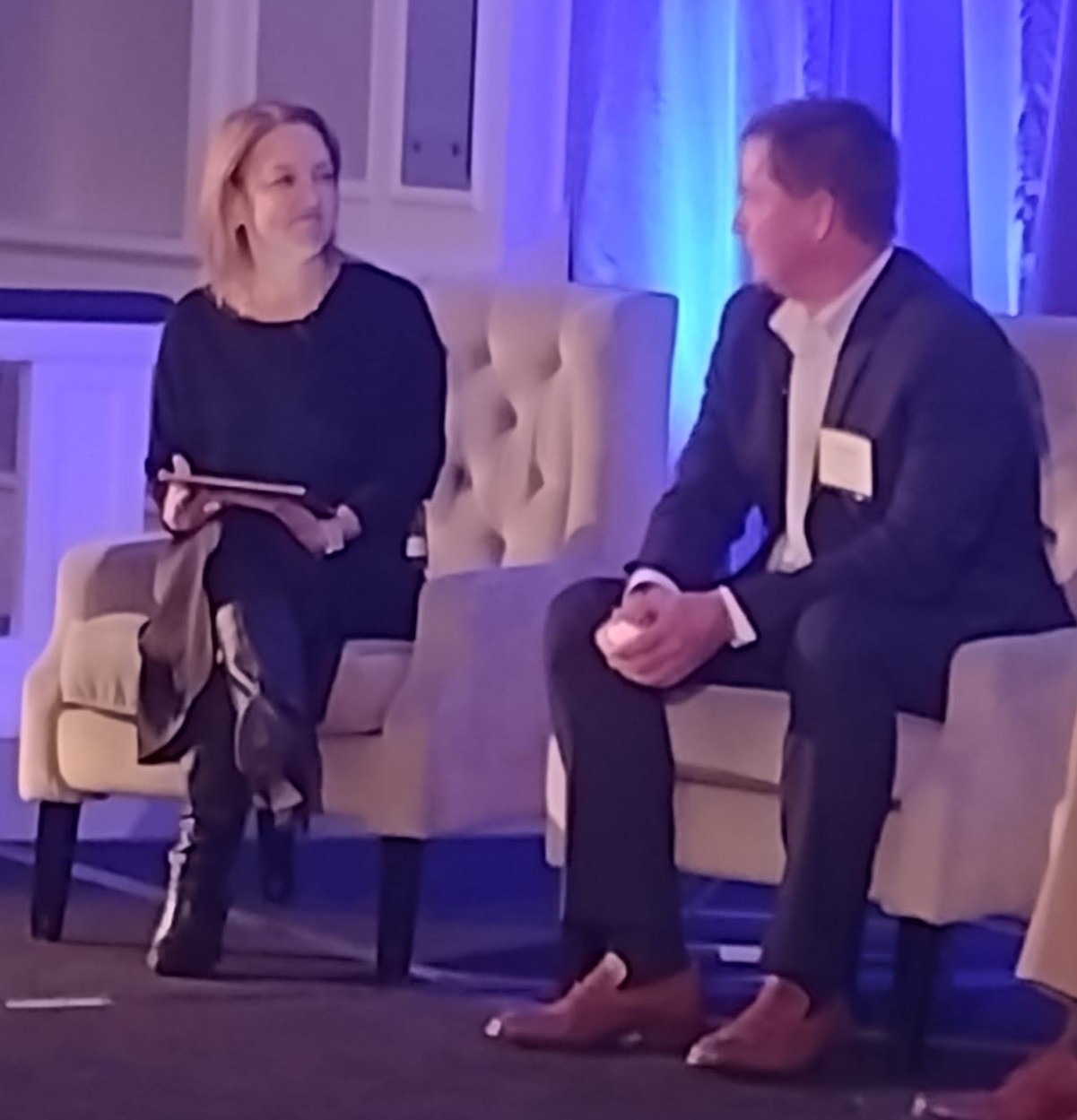
Whisker Labs CEO Bob Marshall discusses innovation with moderator Jennifer Kyung, Vice President and Chief Underwriter at USAA.

While the insurance industry has a critical role to play and is uniquely well equipped to lead the attack, simply transferring risk is not enough. A recurring theme at the Town Hall was the need to shift from a focus on assessing and repairing damage to one of predicting and preventing losses.

Three moderated discussions – examining the nature of climate risk and its costs; highlighting the need of strategic innovation in mitigating those risks and building resilience; and exploring the role and impact of government policy – gave panelists the opportunity to share their insights with a diverse audience focused on collaborative action.

The agenda was:

Climate Risk Is Spiraling: What Can Be Done?

Moderator: David Wessel, Senior Fellow and Director at the Brookings Institution and former Economics Editor for The Wall Street Journal.

Panelists:

Dr. Philip Klotzbach, Colorado State University, researcher and Triple-I non-resident scholar.

Dan Kaniewski, Managing Director, Public Sector at Marsh McLennan, Former FEMA Deputy Administrator.

Jacqueline Higgins, Head, North America & Senior Vice President, Public Sector Solutions, Swiss Re

Jim Boccher, Chief Development Officer, ServiceMaster.

Jeff Huebner, Chief Risk Officer, CSAA.

Innovation, High- and Low-Tech: How Insurers Are Driving Solutions

Moderator: Jennifer Kyung, VP, Chief Underwriter, USAA.

Panelists:

Partha Srinivasa, EVP, CIO, Erie Insurance.

Sam Krishnamurthy, CTO, Digital Solutions, Crawford.

Bob Marshall, CEO, Whisker Labs.

Stephen DiCenso, Principal,Milliman.

Charlie Sidoti, Executive Director, InnSure.

Outdated Regs to Legal System Abuse: It Will Take Villages to Fix This

Moderator: Zach Warmbrodt, financial services editor, Politico.

Panelists:

Parr Schoolman, SVP and Chief Risk Officer, Allstate.

Tim Judge, SVP, Head Modeler, Chief Climate Officer, Fannie Mae.

Dan Coates, Deputy Director, DRS, Federal Housing Finance Agency.

Fred Karlinsky, Co-Chair of Greenberg Traurig’s Global Insurance Regulatory & Transactions Practice Group.

Panelists and participants alike appreciated the compact, action-focused, conversational nature of the single-afternoon event, as well as the opportunity to discuss areas in which their diverse industry- or sector-specific priorities and efforts overlapped.

If you weren’t able to join us in Washington, don’t worry. In his closing remarks, Kevelighan announced plans to take the program on the road with a local and regional focus, so stay tuned. You can contact us if you’re interested in participating in future Town Halls or other Triple-I events. You also can join the “Attacking the Risk Crisis” LinkedIn Group to be part of the ongoing conversation.

Triple-I Town Hall, Nov. 30, in D.C., Targets Climate Risk

Property/casualty insurers have a powerful interest in mitigating climate-related risk and promoting investment in resilience. The industry is uniquely qualified to help address these perils, but traditional risk-transfer mechanisms on their own are no longer sufficient. Collective responsibility and a multi-disciplinary approach are needed for predicting and preventing catastrophic losses.

That’s why Triple-I’s first-ever “Attacking the Risk Crisis” Town Hall is focused on climate-related perils. The one-day event – being held on November 30, 2023, at the Mayflower Hotel in Washington D.C. – will feature three moderated discussions among private-sector innovators, government, academia, and other stakeholder groups whose engagement is necessary to drive resilience investment and behavioral change.

“Climate risk alone is a formidable adversary,” said Triple-I CEO Sean Kevelighan, noting that insured losses related to natural disasters have increased tenfold since the 1980s. “Resource constraints, legal system abuse, economic pressures, and political intricacies further complicate matters.”

Triple-I has long been a participant in the climate-risk conversation, and this Town Hall is part of its effort help turn these discussion into action. It recently played a key role in a project with the National Institute of Building Sciences (NIBS) to develop a roadmap for stakeholders in flood-risk management to drive investment in mitigation and resilience.

Learn more about the NIBS project here.

In the same spirit as the NIBS project, Triple-I is holding this Town Hall to reach across the barriers that often separate sectors that would benefit from investing in resilience to different degrees and in different stages of the value-creation chain.

“Aligning incentives for these diverse co-beneficiaries of resilience investment is a key hurdle to be cleared,” Kevelighan said. “Triple-I’s subject-matter experts have been speaking and publishing on these topics for years. But our industry can’t do it alone.”

The first panel – Climate Risk Is Spiraling – What Can Be Done? – will be moderated by David Wessel, senior fellow in Economic Studies at the Brookings Institution and director of the Hutchins Center on Fiscal and Monetary Policy. This panel will discuss the current state of climate risk and share their insights as practitioners and thought leaders.

The second – Innovation, High- and Low-Tech: How Insurers Are Driving Solutions – will be moderated by Jennifer Kyung, vice president and chief underwriter for USAA, and focus on how the tools, techniques, and strategies insurers are bringing to bear on these complex and costly challenges.

And the third – From Outdated Regs to Legal System Abuse: It Will Take Villages to Fix This – will be moderated by Zach Warmbrodt, financial services editor at Politico, and panelists will delve into the legal and public policy considerations that need to be addressed to move the needle on climate resilience.

Solution-focused and organized with an eye toward driving positive action across stakeholder groups, this event is an opportunity to meet and interact with people who are doing the work and developing the strategies and tactics. Hear and share insights and – perhaps most important – get involved in the attack on the risk crisis.

You can register and check out the agenda and speaker profiles here.

Attacking the Risk Crisis: Roadmap to Investment
in Flood Resilience

As part of its attack on the risk crisis, Triple-I recently participated in a project led by the National Institute of Building Sciences (NIBS) to develop a roadmap for mitigation investment incentives. The Resilience Incentivization Roadmap 2.0 builds off research NIBS published in 2019 and focuses on urban pluvial flooding, though many of the principles can be applied to riverine and coastal flooding, as well as non-flood perils.

The roadmap draws heavily from voluntary programs that have seen success in the context of other risks – such as the Insurance Institute for Business & Home Safety (IBHS) FORTIFIED Home™ Standard and the California Earthquake Authority’s Brace + Bolt retrofit program.

“Pluvial urban flooding” refers to rainwater that can’t flow downhill fast enough to reach streams and stormwater systems and therefore backs up into buildings. Much of the inland flooding caused by Hurricane Ida (2021), Hurricane Ian (2022), and more recent flooding in California due to “atmospheric rivers” and in the Northeast would fall under this category. Common low-cost measures exist to protect buildings from such flooding, and the relative ease and affordability of such mitigations made pluvial urban flooding an appropriate initial target.

This project was a collaboration representing stakeholders in the built environment – lenders, developers, insurers, engineers, agencies, policymakers – with the goal of helping communities develop layered mitigation investment packages. Triple-I’s role was to represent the property/casualty insurance industry as a stakeholder and co-beneficiary of investment in advance mitigation and resilience.

Insurers have strong incentives to encourage policyholders to make improvements that reduce the risk of costly claims. In the case of flood risk – an increasingly expensive peril outside FEMA-designated flood zones – encouraging such improvements is preceded by a different challenge: persuading homeowners to obtain flood insurance.

About 90 percent of U.S. natural disasters involve flooding. Estimates of size of the “flood protection gap” vary widely among experts, but illustrations worth noting include:

  • Less than 25 percent of buildings inundated by Hurricanes Harvey, Sandy, and Irma had flood coverage;
  • Inland areas hardest hit by the remnants of Hurricane Ida in 2021 were in areas in which less than 2 percent of properties had federal flood insurance;
  • In 2022, historic flooding in and around Yellowstone National Park affected areas in which only 3 percent of residents have federal flood insurance; and
  • More recently, precipitation from atmospheric rivers affecting the U.S. West Coast has resulted in an unparalleled weather event not experienced in several decades, with much of the activity affecting areas with low flood-insurance purchase rates.

For decades, U.S. insurers considered flood risk “untouchable” because of how hard it is to quantify their risk. As a result, flood is excluded under standard homeowners and renters policies, but coverage is available from FEMA’s National Flood Insurance Program (NFIP) and a growing number of private insurers that have gained confidence in recent years in their ability to underwrite this risk using sophisticated risk modeling.

Consumer research has consistently shown that some of the most common reasons for not buying flood insurance include:

  • An erroneous belief that flood risk is covered under standard homeowners insurance;
  • If the mortgage lender doesn’t require flood insurance, it must not be necessary; and
  • The coverage is too expensive.

The roadmap provides findings and specific recommendations developed by its multidisciplinary team of authors in collaboration with broad and diverse participation of stakeholder group members. The NIBS Committee on Finance, Insurance, and Real Estate (CFIRE) will host a webinar on October 18 to go over these findings and recommendations. In addition, CFIRE chair Dan Kaniewski will be a participant in Triple-I’s November 30 Town Hall: Attacking the Risk Crisis in Washington, D.C.

A close-up of a logo

Description automatically generated

Learn More:

Triple-I “State of the Risk” Issues Brief: Flood

Shutdown Threat Looms Over U.S. Flood Insurance

FEMA Incentive Program Helps Communities Reduce Flood Insurance Rates for Their Citizens

More Private Insurers Writing Flood Coverage; Consumer Demand Continues to Lag

NAIC Seeks Granular Data From Insurers to Help Fill Local Protection Gaps

Kentucky Flood Woes Highlight Inland Protection Gap

Inland Flooding Adds a Wrinkle to Protection Gap

How Proposition 103 Worsens Risk Crisis
In California

California is not the only U.S. state struggling with insurance availability and affordability, but — as described in a new Triple-I Issues Brief — its problems are exacerbated by a three-decades-old legislative measure that severely constrains insurers’ ability to profitably insure property in the state.

Instead of letting insurers use the most current data and advanced modeling technologies to inform pricing, Proposition 103 requires them to price coverage based on historical data alone. It also bars insurers from incorporating the cost of reinsurance into their prices.

Insurers’ underwriting profitability is measured using a “combined ratio” that represents the difference between claims and expenses insurers pay and the premiums they collect. A ratio below 100 represents an underwriting profit, and one above 100 represents a loss. 

As the chart shows, insurers have earned healthy underwriting profits on their homeowners business in all but two of the 10 years between 2013 and 2022. However, the claims and expenses paid in 2017 and 2018 – due largely to wildfire-related losses – were so extreme that the average combined ratio for the period was 108.1.

Underwriting profitability matters because that is where the money comes from to maintain “policyholder surplus” – the funds insurers set aside to ensure that they can pay future claims. Integral to maintaining policyholder surplus is risk-based pricing, which means aligning underwriting and pricing with the cost of the risk being covered. Insurers hire teams of actuaries and data scientists to make sure pricing is tightly aligned with risk, and state regulators and lawmakers closely scrutinize insurers to make sure pricing is fair to policyholders.

To accurately underwrite and price coverage, insurers must be able to set premium rates prospectively. As shown above, one or two years that include major catastrophes can wipe out several years of underwriting profits – thereby contributing to the depletion of policyholder surplus if rates are not raised.

California is a large and potentially profitable market in which insurers want to do business, but current loss trends and the constraints of Proposition 103 have caused several to reassess their appetite for writing coverage in the state. Wildfire losses, combined with events like early 2023’s anomalous rains and, more recently, Hurricane Hilary, increase the urgency for California to continue investing in risk reduction and resilience. The state also needs to update its regulatory regime to remove impediments to underwriting.

An effort in the state legislature to rectify some of the issues making California less attractive to insurers failed in September 2023. With fewer private insurance options available, more Californians are resorting to the state’s FAIR plan, which offers less coverage for a higher premium.

Want to know more about the risk crisis and how insurers are working to address it? Check out Triple-I’s upcoming Town Hall, “Attacking the Risk Crisis,” which will be held Nov. 30 in Washington, D.C.

A close-up of a logo

Description automatically generated

It’s Not an “Insurance Crisis” — It’s a Risk Crisis

Ten states – Louisiana, Florida, Idaho, Kentucky, Mississippi, Montana, North Dakota, South Carolina, Texas, and Virginia – as well as additional plaintiffs, are suing the Federal Emergency Management Agency (FEMA) over its new methodology for pricing flood insurance, Risk Rating 2.0. On Sept. 14, a federal hearing lasted six hours as the plaintiffs sought a preliminary injunction to halt the new pricing regime while the lawsuit plays out.

Many residents of these states are understandably upset about seeing their flood insurance premium rates rise under the new approach. There may not be much comfort for them in knowing that the current system is much fairer than the previous one, in which higher-risk homeowners subsidized those with lower risks. Similarly, policyholders who have had their premium rates reduced under Risk Rating 2.0 are unlikely to take to the streets in celebration.

These homeowners aren’t alone in seeing insurance rates rise – or even having to struggle to obtain insurance. And these difficulties aren’t confined to holders of flood insurance policies. Florida and California are two states in which insurers have been forced to rethink their risk appetite – due in part to rising natural catastrophe losses and in part to regulatory and litigation environments that make it increasingly difficult for insurers to profitably write coverage.

Even before the COVID-19 pandemic and Russia’s invasion of Ukraine – and the supply-chain and inflationary pressures they created – the property/casualty insurance market was hardening as insurers adjusted their pricing and their risk appetites to keep pace with conditions that were driving losses up and eroding underwriting profitability – topics Triple-I has written about extensively (see a partial list below).

“Rising insurance rates are not the problem,” says Dale Porfilio, chief insurance officer at Triple-I. “They are a symptom of rising losses related to a range of factors, from climate and population trends to post-pandemic driving behaviors and surging cybercrime to antiquated policies, outdated building codes, fraud, and legal system abuse.”

In short, we are not experiencing an “insurance crisis,” as many media outlets tend to describe the current state of the market; we are experiencing a risk crisis. And even as the states referenced above push back against much-needed flood insurance reform, legislators in several states have been pushing measures that would restrict insurers’ ability to price coverage accurately and fairly – rather than addressing the underlying perils and forces aggravating them.  

Triple-I, its members, and a range of partners are working to educate stakeholders and decisionmakers and promote pre-emptive risk mitigation and investment in resilience. We are using our position as thought leaders and our unique non-lobbying role in the insurance industry to reach across sector boundaries and drive constructive action. You will be hearing more about these efforts over the next few months.

The success of these efforts will require a collective understanding among stakeholders and decisionmakers that for insurance to be available and affordable frequency and severity of risk must be measurably reduced. This will require highly focused, integrated projects and programs – many of them at the community level – in which all stakeholders (co-beneficiaries of these efforts) will share responsibility.

Want to know more about the risk crisis and how insurers are working to address it? Check out Triple-I’s upcoming Town Hall, “Attacking the Risk Crisis,” which will be held Nov. 30 in Washington, D.C.

Learn More:

Shutdown Threat Looms Over U.S. Flood Insurance

FEMA Incentive Program Helps Communities Reduce Flood Insurance Rates for Their Citizens

More Private Insurers Writing Flood Coverage; Consumer Demand Continues to Lag

Shift in Hurricane Season’s Predicted Severity Highlights Need for Prospective Cat Risk Pricing

California Needs to Make Changes to Address Its Climate Risk Crisis

Illinois Bill Highlights Need for Education on Risk-based Pricing of Insurance Coverage

IRC Outlines Florida’s Auto Insurance Affordability Problems

Education Can Overcome Doubts on Credit-Based Insurance Scores, IRC Survey Suggests

Matching Price to Peril Helps Keep Insurance Available & Affordable

Triple-I “State of the Risk” Issues Brief: Flood

Triple-I “State of the Risk” Issues Brief: Hurricanes

Triple-I Issues “Trends and Insights” Brief: Risk-Based Pricing of Insurance

Shutdown Threat Looms Over U.S. Flood Insurance

Even as the 2023 Atlantic hurricane season proves to be more intense than originally predicted, federal funding for the National Flood Insurance Program (NFIP) is threatened by a potential government shutdown. Funding for NFIP will expire after September 30 if lawmakers don’t reach a deal.

Claims on existing policies would still get paid if NFIP isn’t reauthorized. But the program would be unable to issue new policies and would face other funding constraints. If it can’t issue new policies, thousands of real estate transactions requiring flood coverage could be derailed. 

Insured losses from hurricanes have risen over just the past 15 years. When adjusted for inflation, nine of the 10 costliest hurricanes in U.S. history have struck since 2005. This is due in large part to the fact that more people have been moving into harm’s way since the 1940s, and Census Bureau data show that homes being built are bigger and more expensive than before. Bigger homes filled with more valuables means bigger claims when a flood occurs – a situation exacerbated by continuing replacement cost inflation.

Flooding isn’t just a problem for East and Gulf Coast communities. Inland flooding also is on the rise. In August 2021, Hurricane Ida brought heavy flooding to the Louisiana coast before delivering so much water to the northeast that Philadelphia and New York City saw flooded subway stations days after the storm passed. Floods in Eastern Kentucky in 2022 further underscored the need for more comprehensive planning on how to deal with these disasters and reduce the nationwide flood protection gap. California and the Pacific Northwest have been hit in recent years by drenching “atmospheric rivers” and, most recently, Hurricane Hilary, which slammed Southern California and neighboring Nevada, where it turned the Burning Man festival in the state’s northern desert into a dangerous mess of foot-deep mud and limited supplies.

Flood insurance is provided by NFIP and a small but growing number of private insurers, who have become increasingly comfortable writing the coverage since the advent of sophisticated modeling and analytical tools. Between 2016 and 2022, the total flood market grew 24 percent – from $3.29 billion in direct premiums written (DPW) to $4.09 billion – with 77 private companies writing 32.1 percent of the business.

Flood risk was long considered untouchable by private insurers, which is a large part of the reason the federally run NFIP exists. While private participation in the flood market is growing, NFIP remains a critical source of protection for this growing and underinsured peril.

Want to know more about the risk crisis and how insurers are working to address it? Check out Triple-I’s upcoming Town Hall, “Attacking the Risk Crisis,” which will be held Nov. 30 in Washington, D.C.

Learn More:

FEMA Incentive Program Helps Communities Reduce Flood Insurance Rates for Their Citizens

More Private Insurers Writing Flood Coverage; Consumer Demand Continues to Lag

Stemming a Rising Tide: How Insurers Can Close the Flood Protection Gap
Kentucky Flood Woes Highlight Inland Protection Gap

Inland Flooding Adds a Wrinkle to Protection Gap

State of the Risk Issues Brief: Flood

State of the Risk Issues Brief: Hurricanes

NAIC Seeks Granular Data From Insurers to Help Fill Local Protection Gaps

Data is at the core of risk management, and the National Association of Insurance Commissioners (NAIC) is seeking to identify gaps in the data state regulators collect from insurers – particularly with respect to understanding insurance availability and affordability.

“The increasing frequency and severity of weather events, rising reinsurance costs, and inflationary pressures are making property insurance availability and affordability more challenging for a growing number of regions across the U.S.,” the NAIC said in a statement during its Summer National Meeting in August. “These dynamics can vary within a relatively small geographic area, so while a state’s property insurance market may be generally healthy overall, there can be localized protection gaps that challenge certain communities.”

The NAIC said states may lack the kind of data needed to gauge the availability and affordability of insurance for consumers. Under Alan McClain, Arkansas insurance commissioner and chair of the NAIC Property and Casualty Committee, insurance regulators of at least 30 states have started work to identify where data is lacking. The plan is to develop a data template to establish “a long-term, robust data collection strategy to help regulators more nimbly respond to inquiries related to their property markets versus a one-time data call.”

This approach contrasts with one proposed last year by the U.S. Treasury’s Federal Insurance Office (FIO). In its request for information (RFI), FIO proposed collecting data related to “insurers’ underwriting metrics and related insurance policy information.”  It said the data “is needed in order for FIO to identify and more accurately assess the financial impact of weather-related events on insurers’ exposures and underwriting over time. FIO’s analysis would assess insurance availability and its effects on policyholders, particularly in regions of the country with the potential for major disruptions of private insurance coverage due to climate-related disasters.”

Triple-I responded to the FIO RFI by saying, in part, that:

  • The proposed call was duplicative and would ultimately hurt the people FIO wants to help;
  • The ZIP Code-level data FIO said it was seeking could lead to misleading conclusions; and
  • FIO could secure the information it needs from existing, publicly available data without placing an additional reporting burden on insurers.

Triple-I provided an extensive but not exhaustive list of resources for FIO to consider.

“There is no dearth of information to help FIO and policymakers address the conditions contributing to climate risk and drive the behavioral changes needed in the near, intermediate, and long term,” Triple-I wrote, reminding FIO that catastrophe-modeling firms prepare their industry exposure databases from public sources, not insurer data calls. “What is needed is to build on existing efforts and draw on the voluminous data and analysis already extant to target problem areas that are well understood.”

NAIC’s response to the RFI emphasized the importance of collaboration to address concerns about insurance availability and affordability and expressed displeasure at what it characterized as FIO’s “unilateral process.”

“While we recognize the Treasury’s desire to better understand the impact of climate risk and weather-related exposures on the availability and affordability of the homeowners’ insurance market,” NAIC wrote, “we are disappointed and concerned that Treasury chose not to engage insurance regulators in a credible exercise to identify data elements gathered by either the industry or the regulatory community.”

In a June 2023 report, FIO references the RFI and describes the proposed data call, stating that the comment period closed in December 2022 and that FIO is “assessing next steps.” The June report recognizes and commends the industry’s and the NAIC’s efforts to date but goes on to say that these efforts “are fragmented across states and limited in several critical ways.”

FIO makes 20 recommendations, and the report provides context for each, highlighting efforts already under way and explaining how implementation of the FIO recommendations could improve management and supervision of climate-related risks. It also proposes areas of focus for future work by state insurance regulators and the NAIC.

Learn More:

Data Call Would Hinder Climate-Risk Efforts More Than It Would Help

Federal Insurance Office (FIO) request for information (RFI)

Triple-I response to FIO RFI