

Tag Archives: Reinsurance

Triple-I Features Lloyd’s in Latest Issue Brief

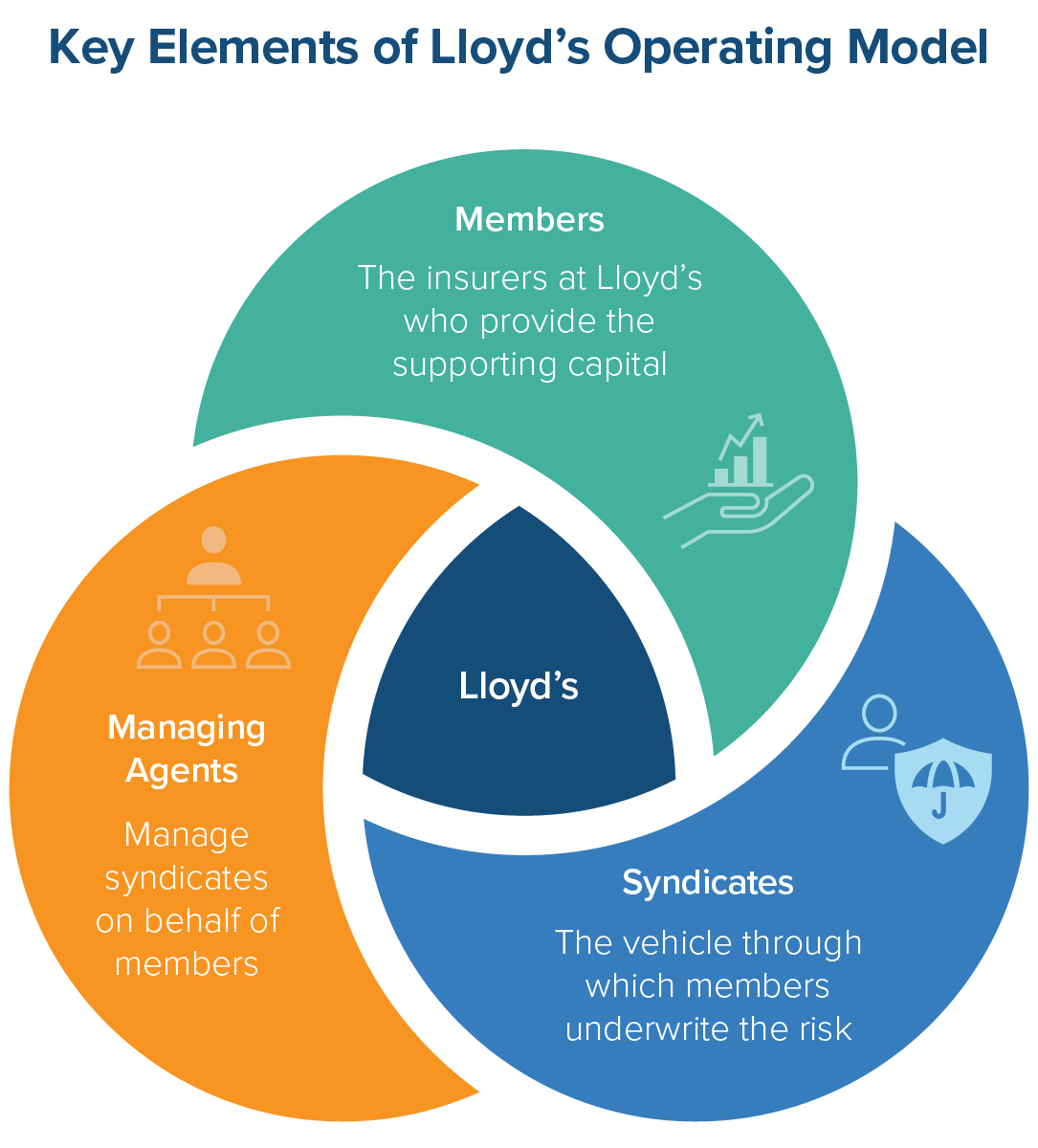
A diagram of Lloyd's, depicting the integration of the 3 core groups in the marketplace: Members, Syndicates, and Managing Agents

Triple-I’s latest Issues Brief, Lloyd’s: Trends and Insights, spotlights one of the world’s leading specialist insurance and reinsurance marketplaces. The brief explains how the nearly 350-year-old platform has functioned differently from the common stand-alone model while evolving into an integral source of capacity and resilience for the global 21st-century risk landscape.

Contrary to a common misperception, Lloyd’s is not a single insurer; rather it’s a marketplace – i.e. hub, network, platform – connecting risk brokers, underwriters, and capital providers who negotiate the transfer of risk. It consists of three core groups:

  • Members: Persons or corporate entities that provide the capital that funds a syndicate.
  • Syndicates: An accounting construct with assets, liabilities, and Profit and Loss (P&L) statement segregated from those of other Lloyd’s syndicates.
  • Managing Agents: Entities appointed by syndicate members to handle underwriting and claims, as well as oversee the governance and operations on behalf of the syndicates.

The arrangement allows policies to have multiple underwriters, enabling each underwriter to  take on more risk than they would have the appetite for as a sole underwriter. As a result, complex and hard-to-place risks can be covered.

​Another distinctive feature of Lloyd’s is its capital structure, also known as the “Chain of Security.”  The brief explains how the Chain of Security is designed to provide the financial backing for all insurance policies written at Lloyd’s. As a result of this setup, the major rating agencies typically apply a single financial strength rating (FSR) to all the policies written through Lloyd’s, regardless of which syndicates participate in the policy.

Successful handling of long-tail and complex risks –  where claims may emerge decades later  –  can be vital to fostering confidence in the larger insurance industry. Throughout its long history, Lloyd’s has been called upon to absorb extreme and unexpected losses while paying claims and recapitalizing. This track record includes playing a key role in supporting U.S. economic recovery, from major disasters, such as the 1906 San Francisco earthquake, the September 11 attacks, Hurricane Katrina, and more recent hurricanes and wildfires.

Managing uncertainty in today’s fast-evolving risk landscape can require keeping abreast of interconnected threats that outpace traditional risk management strategies. Insurers and risk managers can improve the prediction and prevention of emerging threats across core strategic areas:

  • ​advancing analytics capabilities
  • strengthening capital resilience
  • collaborating across the industry

Centering these objectives, Lloyd’s cultivates channels for talent development, innovation, and new capital flows.

For example, its London Bridge 2 (LB2) platform gives institutional investors a flexible and efficient means to deploy funds into the Lloyd’s market, attracting approximately $2.5 billion in new capital since its launch in 2022. Lloyd’s education platform supports the sustainable growth of the market by equipping professionals with the insight needed to navigate the emerging risk landscape. And, Lloyd’s Lab – a product development accelerator designed to rapidly develop, test, and refine new products, concepts, and solutions – supported 48 U.S. startups, which collectively have raised $490 million to scale solutions tackling wildfire, flood, and cyber risks.

The United States is Lloyd’s largest market, accounting for roughly half of the marketplace’s global premiums. Excess and surplus underwriting accounts for over 60 percent of Lloyd’s total premiums written in the U.S. In 2024, this share worked out to $20.8 billion in surplus lines insurance capacity, approximately 16 percent of the entire U.S. surplus lines market.  Additionally, Lloyd’s gross written premiums for U.S. reinsurance totaled $9.86 billion in 2024, with the marketplace ceding around $2.9 billion annually in reinsurance premiums to U.S. reinsurers.

This special edition of the Triple-I issue brief series is part of ongoing efforts to educate and raise awareness about how insurance market participants support coverage affordability and availability.

How Proposition 103 Worsens Risk Crisis
In California

California is not the only U.S. state struggling with insurance availability and affordability, but — as described in a new Triple-I Issues Brief — its problems are exacerbated by a three-decades-old legislative measure that severely constrains insurers’ ability to profitably insure property in the state.

Instead of letting insurers use the most current data and advanced modeling technologies to inform pricing, Proposition 103 requires them to price coverage based on historical data alone. It also bars insurers from incorporating the cost of reinsurance into their prices.

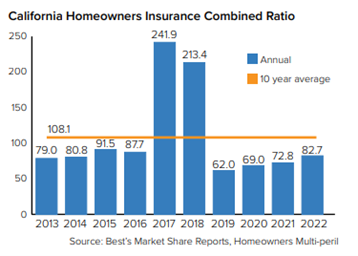
Insurers’ underwriting profitability is measured using a “combined ratio” that represents the difference between claims and expenses insurers pay and the premiums they collect. A ratio below 100 represents an underwriting profit, and one above 100 represents a loss. 

As the chart shows, insurers have earned healthy underwriting profits on their homeowners business in all but two of the 10 years between 2013 and 2022. However, the claims and expenses paid in 2017 and 2018 – due largely to wildfire-related losses – were so extreme that the average combined ratio for the period was 108.1.

Underwriting profitability matters because that is where the money comes from to maintain “policyholder surplus” – the funds insurers set aside to ensure that they can pay future claims. Integral to maintaining policyholder surplus is risk-based pricing, which means aligning underwriting and pricing with the cost of the risk being covered. Insurers hire teams of actuaries and data scientists to make sure pricing is tightly aligned with risk, and state regulators and lawmakers closely scrutinize insurers to make sure pricing is fair to policyholders.

To accurately underwrite and price coverage, insurers must be able to set premium rates prospectively. As shown above, one or two years that include major catastrophes can wipe out several years of underwriting profits – thereby contributing to the depletion of policyholder surplus if rates are not raised.

California is a large and potentially profitable market in which insurers want to do business, but current loss trends and the constraints of Proposition 103 have caused several to reassess their appetite for writing coverage in the state. Wildfire losses, combined with events like early 2023’s anomalous rains and, more recently, Hurricane Hilary, increase the urgency for California to continue investing in risk reduction and resilience. The state also needs to update its regulatory regime to remove impediments to underwriting.

An effort in the state legislature to rectify some of the issues making California less attractive to insurers failed in September 2023. With fewer private insurance options available, more Californians are resorting to the state’s FAIR plan, which offers less coverage for a higher premium.

Want to know more about the risk crisis and how insurers are working to address it? Check out Triple-I’s upcoming Town Hall, “Attacking the Risk Crisis,” which will be held Nov. 30 in Washington, D.C.

A close-up of a logo

Description automatically generated

Pandemic Insurance Was Available. Why Didn’t Businesses Purchase It?

By James Ballot, Senior Advisor, Strategic Communications, Triple-I

Business interruption policies generally exclude losses from closures due to virus or bacteria. Yet insurance against losses due to a pandemic like COVID-19 did in fact exist well before the first case of COVID-19 was reported in the U.S. A recent Wired article, We Can Protect the Economy From Pandemics. Why Didn’t We? gives an in-depth look at the origins and development of pandemic insurance–and why it was ignored by business owners and risk managers who potentially stood to gain the most (or lose the least) from having it.

On the surface, the article’s author recounts the sort of innovation and ingenuity that most of us familiar with insurance can easily recognize. But just beneath is a fascinating glimpse at how insurers, virologists and epidemiologists, and data scientists devised ways to understand and rationalize the economics of outbreaks—and at the amazing race to quantify and price pandemic risks to bring an insurance product to market.

“Reinsurance is sometimes called the business of a hundred professions … you don’t just have mathematicians and lawyers and businessmen. You have former mining engineers. You have former captains who steered ships across the ocean. You have art experts who are specialized in art insurance. It is, if you like, always close to life.”

–from, We Can Protect the Economy From Pandemics. Why Didn’t We?

Like many significant advances, pandemic insurance started from a conventional, even humble proposition. In 2011, with the 2008 Ebola outbreak still fresh in the collective memory, Gunther Kraut, then a young quantitative analyst at Munich Re, studied ways for his firm to hedge its life insurance portfolio against a “one-in-500-year return period.”

Kraut later partnered with Nathan Wolfe, a globetrotting rock-star virologist, and Nita Madhav, an epidemiologist who’d spent 10 years modeling catastrophes for the insurance industry, to create what was essentially a new consciousness about pandemic risk—and tools to help mitigate potentially immense losses.

Without trifling, this is a gripping saga involving global NGOs, multinational corporate giants, visionary business derring-do, and catastrophic failures of the imagination. But from its pages, we get a fuller understanding of insurance as a pervasive force that, in spite of its sophistication, ubiquity and capacity for good, nevertheless sometimes bows to the principles of behavioral economics.