

Tag Archives: Excess and surplus

Triple-I Features Lloyd’s in Latest Issue Brief

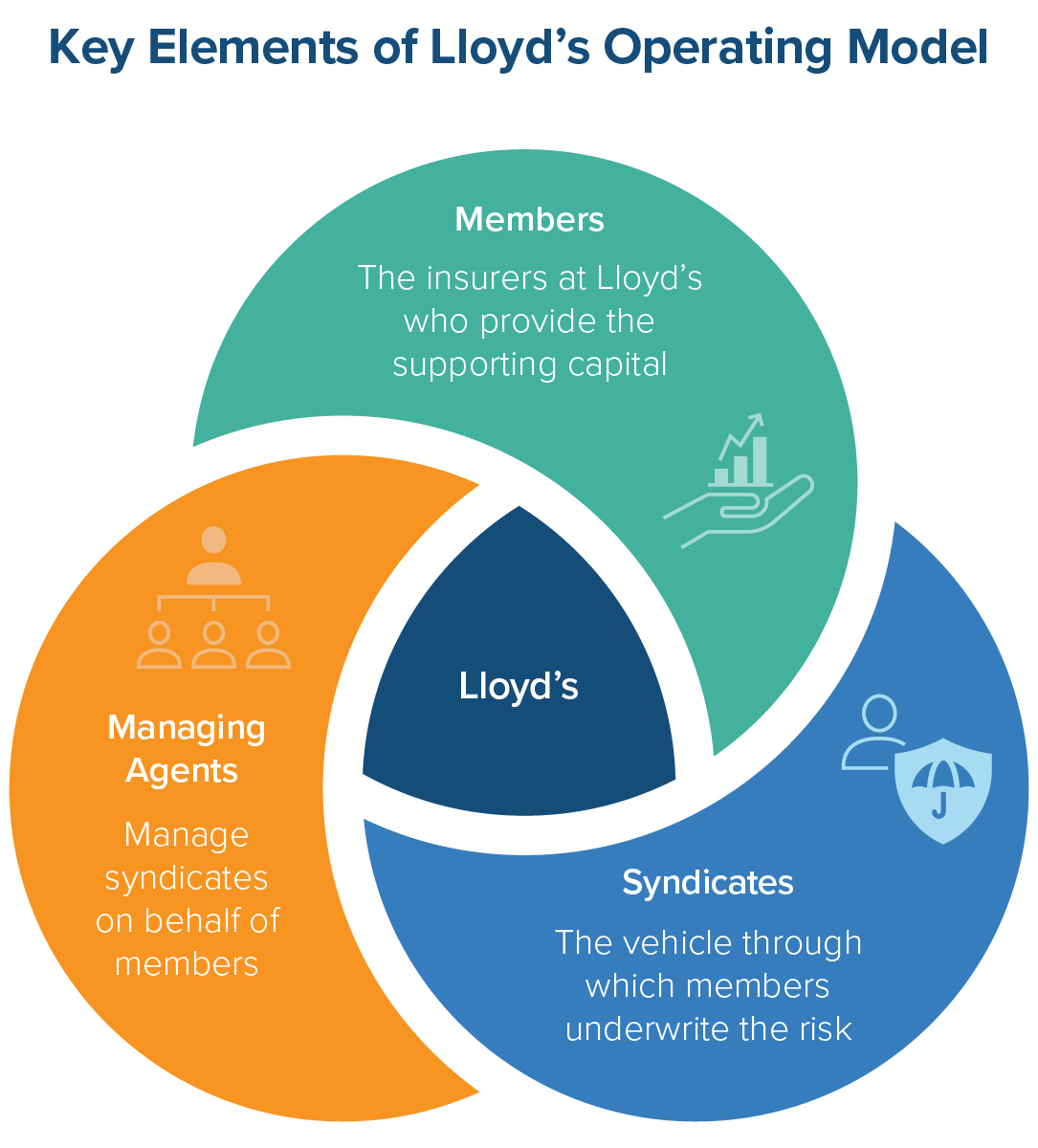
A diagram of Lloyd's, depicting the integration of the 3 core groups in the marketplace: Members, Syndicates, and Managing Agents

Triple-I’s latest Issues Brief, Lloyd’s: Trends and Insights, spotlights one of the world’s leading specialist insurance and reinsurance marketplaces. The brief explains how the nearly 350-year-old platform has functioned differently from the common stand-alone model while evolving into an integral source of capacity and resilience for the global 21st-century risk landscape.

Contrary to a common misperception, Lloyd’s is not a single insurer; rather it’s a marketplace – i.e. hub, network, platform – connecting risk brokers, underwriters, and capital providers who negotiate the transfer of risk. It consists of three core groups:

  • Members: Persons or corporate entities that provide the capital that funds a syndicate.
  • Syndicates: An accounting construct with assets, liabilities, and Profit and Loss (P&L) statement segregated from those of other Lloyd’s syndicates.
  • Managing Agents: Entities appointed by syndicate members to handle underwriting and claims, as well as oversee the governance and operations on behalf of the syndicates.

The arrangement allows policies to have multiple underwriters, enabling each underwriter to  take on more risk than they would have the appetite for as a sole underwriter. As a result, complex and hard-to-place risks can be covered.

​Another distinctive feature of Lloyd’s is its capital structure, also known as the “Chain of Security.”  The brief explains how the Chain of Security is designed to provide the financial backing for all insurance policies written at Lloyd’s. As a result of this setup, the major rating agencies typically apply a single financial strength rating (FSR) to all the policies written through Lloyd’s, regardless of which syndicates participate in the policy.

Successful handling of long-tail and complex risks –  where claims may emerge decades later  –  can be vital to fostering confidence in the larger insurance industry. Throughout its long history, Lloyd’s has been called upon to absorb extreme and unexpected losses while paying claims and recapitalizing. This track record includes playing a key role in supporting U.S. economic recovery, from major disasters, such as the 1906 San Francisco earthquake, the September 11 attacks, Hurricane Katrina, and more recent hurricanes and wildfires.

Managing uncertainty in today’s fast-evolving risk landscape can require keeping abreast of interconnected threats that outpace traditional risk management strategies. Insurers and risk managers can improve the prediction and prevention of emerging threats across core strategic areas:

  • ​advancing analytics capabilities
  • strengthening capital resilience
  • collaborating across the industry

Centering these objectives, Lloyd’s cultivates channels for talent development, innovation, and new capital flows.

For example, its London Bridge 2 (LB2) platform gives institutional investors a flexible and efficient means to deploy funds into the Lloyd’s market, attracting approximately $2.5 billion in new capital since its launch in 2022. Lloyd’s education platform supports the sustainable growth of the market by equipping professionals with the insight needed to navigate the emerging risk landscape. And, Lloyd’s Lab – a product development accelerator designed to rapidly develop, test, and refine new products, concepts, and solutions – supported 48 U.S. startups, which collectively have raised $490 million to scale solutions tackling wildfire, flood, and cyber risks.

The United States is Lloyd’s largest market, accounting for roughly half of the marketplace’s global premiums. Excess and surplus underwriting accounts for over 60 percent of Lloyd’s total premiums written in the U.S. In 2024, this share worked out to $20.8 billion in surplus lines insurance capacity, approximately 16 percent of the entire U.S. surplus lines market.  Additionally, Lloyd’s gross written premiums for U.S. reinsurance totaled $9.86 billion in 2024, with the marketplace ceding around $2.9 billion annually in reinsurance premiums to U.S. reinsurers.

This special edition of the Triple-I issue brief series is part of ongoing efforts to educate and raise awareness about how insurance market participants support coverage affordability and availability.
Prodigious growth continues for the excess and surplus market, but how long will it last?

The Excess and Surplus (E&S) market has grown for five consecutive years by double-digit percentage rates. While expansion appears to have slowed, ample growth likely to continue if major trends persist, according to Triple-I’s latest issue brief, Excess and Surplus: State of the Risk.

As reported by S&P Global Intelligence, total premiums for 2023 reached $86.47 billion, up from $75.51 billion in 2022. The growth rate for direct premiums in 2023 climbed to 14.5 percent, down from the peak year-over-year (YoY) increase of 32.3 percent in 2021 and 20.1 percent in 2022. The share of U.S. total direct premiums written (DPW) for P/C in 2023 grew to 9.2 percent, up from 5.2 percent in 2013.

The brief summarizes how these outcomes are driven by the niche segment’s capacity to take advantage of coverage gaps in the admitted market and quickly pivot to new product development in the face of emerging or novel risks. Analysis and takeaways, based on data from US-based carriers, highlight dynamics that may support continued market expansion:

  • The rising frequency of climate disasters and catastrophes that overwhelm the admitted market
  • The increasing number and amount of outsized verdicts (awards over $10 million)
  • The sustainability of amenable regulatory frameworks
  • Outlook for the reinsurance segment

These factors can also converge to enhance or aggravate conditions.

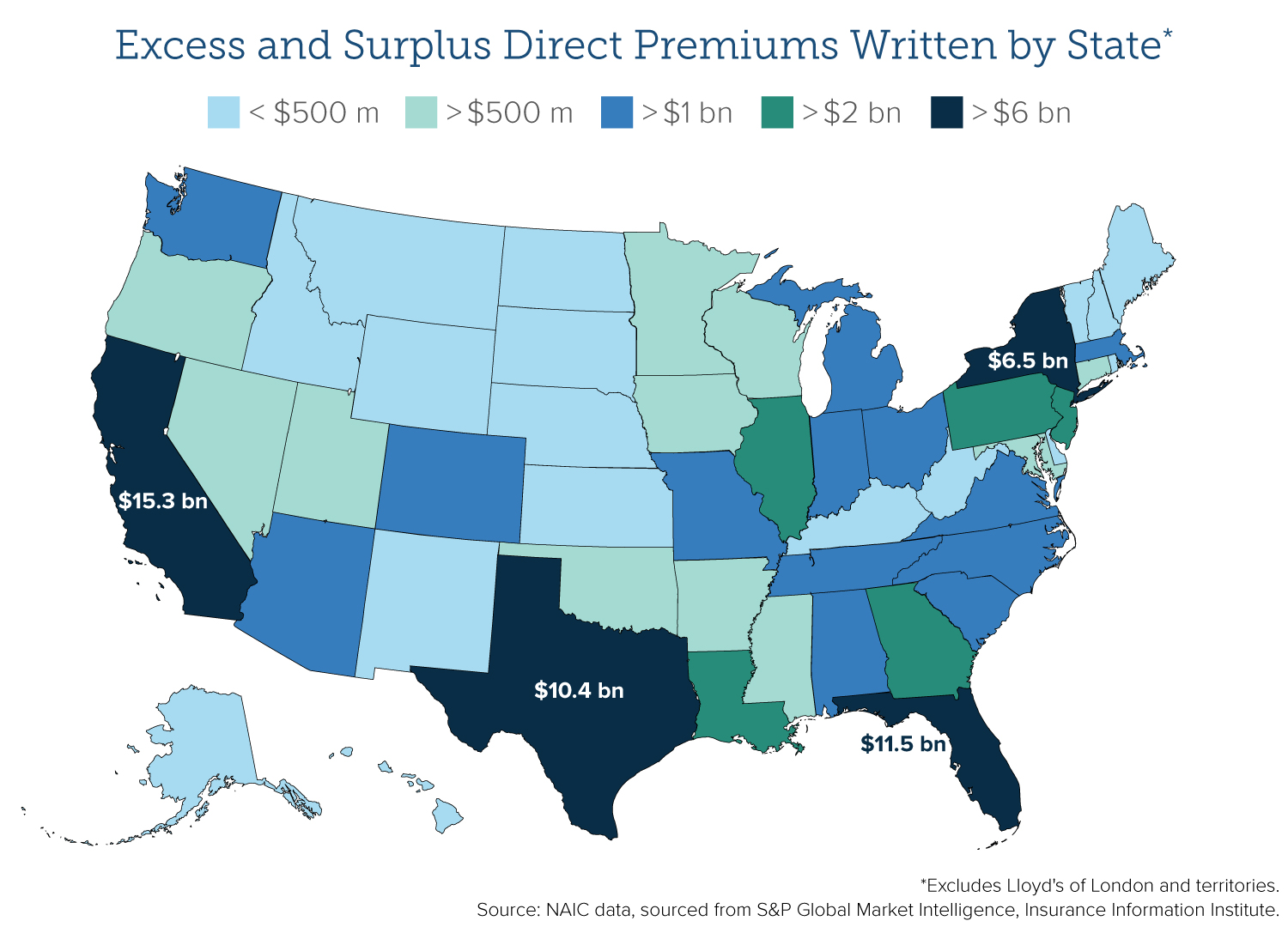
For example, some states, such as Florida and California, are dealing with significant obstacles to P/C affordability and availability in the admitted market posed by catastrophe and climate risk while also experiencing large respective shares of outsized verdict activity. Also, 13 of the 15 largest U.S. E&S underwriters for commercial auto liability experienced a YoY increase in 2023 direct premiums written. In contrast, eight of the largest 15 underwriters of commercial auto physical damage coverage experienced a decline. Given 2023 research from the Insurance Information Institute showing how inflationary factors from legal costs amplify claim payouts for commercial auto liability, it appears that E&S is flourishing off the struggles of the admitted market.              

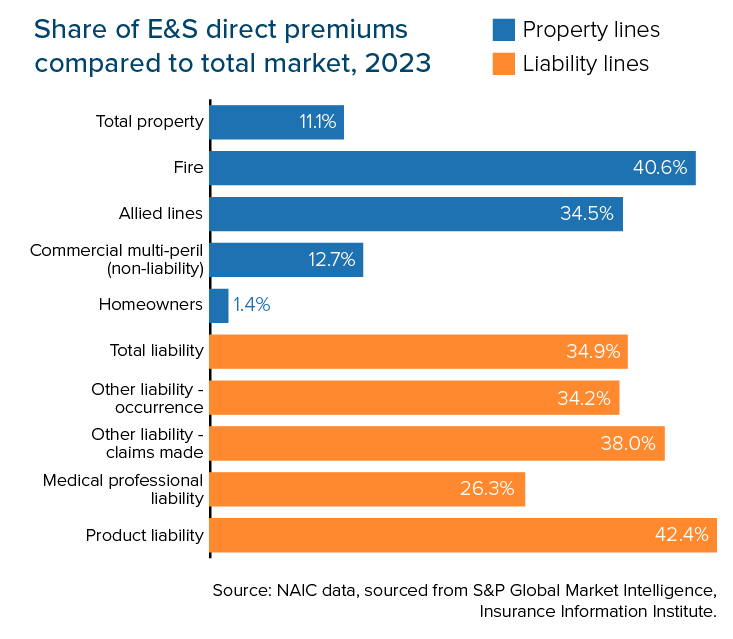
At the state level, the top three states based on E&S property premiums as portion of the total property market were Louisiana (22.7 percent), Florida (21.1 percent), and South Carolina (19.4  percent) in 2023. The states experiencing the highest growth rates in E&S share of property premiums were South Carolina (9.0 percent), California (8.8 percent), and Louisiana (8.3 percent).

Since the publication of Triple-I’s brief, AM Best released its 2024 Market Segment Report on U.S. Surplus Lines. One of the key updates: after factoring in numbers from regulated alien insurers and Lloyd’s syndicates, the E&S market exceeded the $100 billion premium ceiling for the first time, climbing past $115 billion. The share size in the P/C market has more than tripled, from 3.6 percent total P/C DPW in 2000 to 11.9 percent in 2023. Findings also indicate that DPW is concentrated heavily within the top 25 E&S carriers (ranked by DPW), with about 68% of the total E&S market DPW coming from this group.

The E&S market typically provides coverage across three areas:

  • Nonstandard risks: potential liabilities that have unconventional underwriting characteristics
  • Unique risks: admitted carriers don’t offer a filed policy form or rate, or there is limited loss history information available
  • Capacity risks: the customer to be insured seeks a higher level of coverage than most insurers are willing to provide

Thus, E&S carriers offer coverage for hard-to-place risks, stepping in where admitted carriers are unwilling or unable to tread. It makes sense that the policies typically come with higher premiums, which can boost DPW.

However, the value proposition for E&S policyholders hinges on the lack of coverage in the admitted market and the insurer’s financial stability – especially since state guaranty funds don’t cover E&S policies. Therefore, minimum capitalization requirements tend to higher for E&S than for admitted carriers. Ratings from A&M Best over the past several years indicate that most surplus insurers stand secure. Robust underwriting and strong reinsurance capital positions will play a role in the market’s capacity for continued expansion.

To learn more, read our issue brief and follow our blog for the latest insights.