
Tag Archives: #resilience3i

COTW: Native Americans Face Heightened Extreme Weather Risks. 

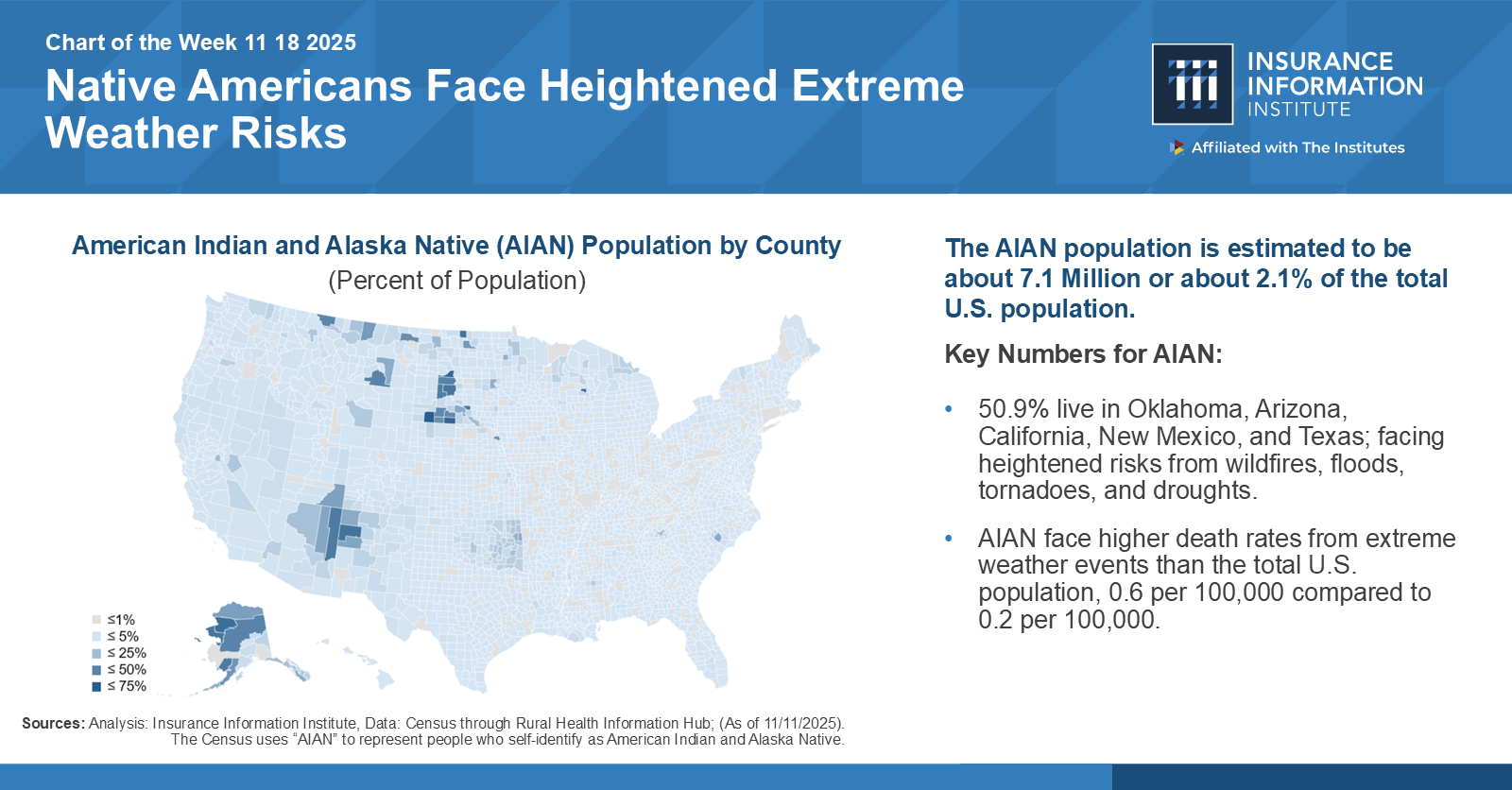
The bottom background color is white and displays a chart to the left and a text box to the right 

Chart Details: 

Title: American Indian and Alaska Native (AIAN) Population by County 


Subtitle: (Percent of Population)  


Chart description: A map colored by county in varying shades of blue  

Chart Data available upon request. 

The source data line reads: Sources: Analysis: Insurance Information Institute, Data: Census through Rural Health Information Hub; (As of 11/11/2025). 

The Census uses “AIAN” to represent people who self-identify as American Indian and Alaska Native. 
The first line of text, in a dark blue bolded font: The AIAN population is estimated to be about 7.1 Million or about 2.1% of the total U.S. population.  


Below, in plain black font, it says Key Numbers for AIAN: 

followed by the following two  lines, each sentence a bullet point:  

50.9% live in Oklahoma, Arizona, California, New Mexico, and Texas; facing heightened risks from wildfires, floods, tornadoes, and droughts. 

AIAN face higher death rates from extreme weather events than the total U.S. population, 0.6 per 100,000 compared to 0.2 per 100,000.
Chart of the Week 11 18 2025: Native Americans Face Heightened Extreme Weather Risks

As part of an ongoing discussion on the link between the housing and insurance markets, the Insurance Information Institute (Triple-I) released a Chart of the Week (COTW) that provides a snapshot of climate risk concerns for American Indian and Alaska Native (AIAN) population.

The provided estimate for the number of Native Americans in the U.S. is 7.1 million – about 2.1 percent of the total population. As much as 95 percent of the general U.S. population lives in a county that has experienced a natural disaster since 2011. However, this COTW says at least 50.9 percent of Native Americans live in states facing heightened risks from wildfires, floods, tornadoes, and droughts. The chart also reveals that Indigenous people in the U.S. face higher death rates from extreme weather events than the total national population, at 0.6 per 100,000 compared to 0.2 per 100,000.

Native communities are situated on the front line of climate risk.

As insurance is designed to help policyholders and their communities recover from insurable events, coverage availability and affordability can contribute to resilience. However, states that are home to at least half of the U.S. Native American population rank high on the Insurance Research Council (IRC) report, Homeowners Insurance Expenditures as a Percent of Median Household Income – Oklahoma (4th), Arizona (5th), Texas, (6th), New Mexico (14th), California (25th) – indicating comparatively less coverage affordability in those states. While availability and affordability can ultimately be driven by a mix of key underlying cost drivers, climate risk and home-ownership challenges can play a crucial role in access for many Native American homeowners.

Extreme weather events, such as hurricanes and typhoons, have shaped the way colonization of North America unfolded, beginning in the early centuries of European contact. For thousands of years prior, Native Americans had thrived in their homelands by taking measures to survive long-term severe weather, such as seasonally migrating away from flood-prone areas or building nature-based infrastructure as needed. Colonial expansion, in which Indigenous people lost nearly 99 percent of their historical land base over time, decimated Indigenous populations and pushed survivors into high-severe-weather-risk areas or lands, in many cases previously unknown to their respective tribal groups.

As a result of centuries of these forced removal policies and government-directed or sanctioned land dispossession, present-day Native American lands “are also generally far from historical lands, averaging a distance of roughly 150 miles” and are often in inherently more climate risk-prone areas today – i.e., low-lying, exposed, less habitable due to drought, etc. Living today on the front lines of climate risk across the U.S. means frequently experiencing acute effects, such as thawing permafrost, rising sea levels, increased flooding, stronger storms, erosion, and shifting ecosystems.

For instance, a 2024 study indicates that Oklahoma, home to 39 federally recognized tribal nations, “faces climate and demographic changes that disproportionately put many Native Americans at risk. The heavy rainfall, 2-year floods, and flash floods are all projected to have increased risks by 501.1 percent, 632.6 percent, and 296.4 percent, respectively.”

In a village in western Alaska, where permafrost is thawing, buildings (including a preschool) are shifting, water intrusion is increasing, and relocation is becoming a real threat. Recently, nearly 50 Alaska Native communities experienced “towering wind speeds, record storm surge, and widespread flooding”, resulting in at least one death and the displacement of 1,500 people. Initial estimates have reported that the storm decimated 90 percent of homes in the coastal village of Kipnuk and 35 percent in Kwigillingok, “which has also experienced toxic chemicals spilling into its freshwater supply.”

Climate risk can threaten lives and property, of course, but also regional economies, one of the key ingredients in building capacity for resilience. For example, a study of climate-driven economic challenges posed to Navajo Nation, the largest Indian reservation in the U.S., shows that “drought has a larger impact on cattle production than hay production, resulting in total economic losses of $8.2 million and $0.4 million for the cattle and hay sectors, respectively.” Without robust regional economies, infrastructure, or policy support, Native American homeowners and their communities may struggle to adapt or relocate effectively.

Homeownership costs may contribute to the protection gap.

Native American homeowners are more likely to lack coverage if they:

  • Are homeowners living in New Mexico and certain rural areas of Texas
  • have manufactured homes, or
  • own inherited homes.

Data collected through the Home Mortgage Disclosure Act (HMDA) reveals that Native Americans, on average, pay more to finance their homes – in some contexts up to two times more. While that disparity can be attributed to several factors, one major driver is the loan type that appears to be more common among Native borrowers, home-only loans. “Nearly 40 percent of loans to Native American borrowers on reservations were for manufactured homes, compared to 3 percent of loans to White borrowers”. Further, about 8 out of 10 manufactured-home loans were home-only loans.

Home-only loans, a financing tool used for movable personal property in which the lender retains ownership of the property until the borrower fully pays the loan, can make financial sense in some instances. Nonetheless, borrowers typically pay higher interest rates and have fewer consumer protections, such as federal guarantees, than regular mortgages. The pressure of these circumstances may compel the homeowners to carry insufficient coverage, or, when they pay off the loan, none at all.

Federal funding freezes can impede resilience.

Data from the National Congress of American Indians show that “U.S. citizens receive, on average, about $26 per person, per year, from the federal government, while tribal citizens receive approximately $3 per person, per year.”  Recent federal disinvestment in 2025 from crucial risk prevention and management programs and other supportive infrastructure –  including public radio stations which can be used for advance severe weather warnings and coordination of disaster recovery efforts – has exacerbated the burden from longstanding disparities. This decrease in support can also heighten the need for insurance coverage and closing the protection gap.

Amy Cole-Smith, Executive Director for BIIC/ Director of Diversity at The Institutes says, “the numbers are clear: Native Americans face higher exposure to extreme weather, higher insurance burdens, and higher rates of being uninsured. These factors reflect not just climate trends but historical inequities that continue to shape outcomes today. Strengthening coverage access is essential to protecting lives, homes, and cultural continuity.”

As Smith has often expressed, one way the industry can start closing the protection gap is “by having people at the table who understand the lived experiences behind the numbers.”

Triple-I works to advance the conversation around crucial issues in the insurance industry. We invite you to follow our blog to learn more about trends in insurance affordability and availability across the property/casualty market.

Insurance Careers Corner: Q&A with Rahel Abraham, ClimaGuard

By Kris Maccini, Social Media Director, Triple-I

Triple-I’s “Insurance Careers Corner” series was created to highlight trailblazers in the insurance industry and to spread awareness on the career opportunities within the industry.

This month we interviewed Rahel Abraham, CEO of ClimaGuard, a Houston-based start-up that provides protective coverings for cars (and personal belongings) to prevent valuable losses from flood damage. Rahel shared her inspiration for creating ClimaGuard, her experiences as a first-time entrepreneur, and how she prepped her business for hurricane season, amid a pandemic.

Name: Rahel Abraham

Current Role: Founder & CEO, ClimaGuard

Years at Company: 2 years

Tell me about ClimaGuard. What led you to start the company in 2018?

The idea of ClimaGuard came about a month after Hurricane Harvey. This event was a historical devastation – not only were residential homes flooded, but many businesses and vehicles were flooded also. I lost my car, and there was a shortage of rental vehicles. Living in Houston, I depend on my mobility – being vulnerable post the hurricane was a challenge. I realized that I needed help, and so did many of my neighbors.

Shortly after the storm, a friend and I thought of an idea to produce a protective covering. As more hurricanes hit, we realized that flood mitigation wasn’t going to be solved overnight, but that we could come up with a way to help people safeguard themselves in real time. My background prior to ClimaGuard was in Engineering, so I knew that I had the background to create a product that would work.

ClimaGuard protective coverings can be used for other purposes outside of automobiles. I have a client who used it to protect a grandfather clock that was passed down through generations. I wanted the covering to be large enough to fit a car, but easy enough to use for quickly packing other valuable items in the home – sofas, electronics, tables, etc.

As CEO, what’s top of mind as you look to grow your business?

There are two goals that are top of mind: 1.) Spread awareness about flood risks, and 2.) Encourage and empower at-risk communities to proactively mitigate. Education in creating awareness for disaster planning and mitigation is vital to the growth of ClimaGuard. Whatever life looks like post-event – whether it’s running for home supplies, shopping for groceries, or accessing temporary living (hotel) – you need mobility, and, more importantly, peace of mind throughout the event.

It wasn’t until I got flooded that I understood the challenges post-flooding, and the financial costs to recover. I was fortunate to have a support system, but I know individuals who are still trying to recover three years after Harvey. I’m focused on preparing individuals and communities to get back up and running as soon as possible.

Being a woman and Black-owned business, what challenges have you faced in growing the company?

I didn’t know anyone personally who ran a successful product-based company, or any start-up, in general. I quit my job to pursue my business, so my cash flow was limited. I relied on my savings in the beginning, because I didn’t know how to seek funding. I was concerned that I would lock my business into a situation that would prevent it from thriving, if I didn’t partner with the right people. Because I didn’t have the network here, I went overseas to build partnerships, understand manufacturing, and learn how to create opportunities.

What activities have you been involved in to help build networking and partnerships?

Prior to COVID-19, I was part of an accelerator program called DivInc out of Austin, Texas. Austin is a great community for start-ups, and I wanted to be in the mix among entrepreneurs who were also starting from the ground up. After completing that program, I began outreach specifically to dealerships and the insurance industry. These two markets have proven to be good partnership opportunities for ClimaGuard. With insurance, my goal is to touch on the fleet business, the rental car space, and the commercial and residential customer base. With the dealerships, I am seeking access to the residential and commercial buyers who are invested in protecting their assets.

[ClimaGuard is currently a participant in Triple-I’s Resilience Accelerator]

What advice would you give to aspiring entrepreneurs in seeking opportunities and overcoming challenges? 

Just like your ingenuity led to an idea that solves a real problem, that same creative thinking will lead you to solutions to overcome your challenges. Your path is your own, and you don’t need millions of dollars to make your start-up successful. You do not need a proven track record to show you are capable. It’s not a sprint, it’s a marathon, so don’t burn yourself out.

2020 is expected to be one of the worst hurricane seasons on record and the pandemic will bring about new challenges in disaster prep. How have these challenges impacted your business? How are you preparing for the season?

Currently, the nation is highly focused on COVID-19. The lack of attention to this hurricane season concerns me, however we are living in very unusual and uncertain times. Many of us, myself included, are taking things day by day. I’m trying to be observant of the climate and the emotional health of our communities. In terms of preparedness during hurricane season, I know that hurricanes and flash flooding only allow a few days of notice before hitting an area. I’ve ensured that ClimaGuard inventory is ready, and I’m prepared to ship units (with the available supply) through a local fulfillment business in Houston. ClimaGuard’s mission is to prevent loss from natural disasters, and we’re ready this season and preparing for next season. Our goal is increase inventory next year as we develop more opportunities with partners and retailers.

Lightning Rounds: Investing in disaster and risk management technology

The Insurance Information Institute (Triple-I) yesterday hosted a webinar showcasing technology companies whose products mitigate the impact of severe weather on homeowners, businesses and communities. This is the first in a series of Lightning Rounds – fast-paced pitch panels for insurance and non-insurance investors.

The webinar is part of the Resilience Accelerator initiative, a collaboration of Triple-I, ResilientH2O Partners and The Cannon

During the Lightning Rounds, pre-vetted technology companies, equipment suppliers, integrated solution providers, and large-scale project development teams present their unique value propositions.

This Round’s focus was flood prevention. Shelly Klose, CEO of True Flood Risk described the company’s AI-driven risk management platform that provides individual property data, geolocation intelligence and risk scores related to flood risk in real-time without an on-site inspection. Tasha Nielsen Fuller, CEO of FloodFrame USA, presented a system which is installed underground around a structure, and automatically deploys in a flood, protecting the structure. Rahel Abraham, Founder and Chief Executive Officer of ClimaGuard, was inspired to invent a water-resistant wrapping for vehicles and other possessions when her own vehicle was flooded during Hurricane Harvey.

To view a recording of the webinar click on the video above.

Webinar overview

Part 1: A view from the C-Suite: Identifying the right technology and risk solutions

Brian Gaab, Strategy & Innovation, CSAA Insurance Group, a AAA Insurer

Susan Holliday, Senior Advisor, International Finance Corporation | The World Bank Group

Matthew T. Schneider, Co-CEO, Aon Risk Solutions, M&A and Transaction Solutions

Michel Leonard, PhD, CBE (Moderator), Senior Economist & Vice President, The Insurance Information Institute

Part 2: Use Cases: Bringing to market flood management solutions

Presenting Companies:

Shelly Klose, Founder and Chief Executive Officer, True Flood Risk

Tasha Nielsen Fuller, Chief Executive Officer, FloodFrame USA

Rahel Abraham, Founder and Chief Executive Officer, ClimaGuard

Panelists:

Brian Gaab, Strategy & Innovation, CSAA Insurance Group, a AAA Insurer

Susan Holliday, Senior Advisor, International Finance Corporation | The World Bank Group

Matthew T. Schneider, Co-CEO, Aon Risk Solutions, M&A and Transaction Solutions

Remington Tonar, Chief Resilience Officer and Senior Advisor, The Cannon

Richard Seline (Moderator), Managing Partner, ResilientH2O Partners

Colorado State University issues updated forecast for 2020 hurricane activity

The 2020 Atlantic hurricane season activity is still projected to be “well above average,” according to Triple-I non-resident scholar, Dr. Phil Klotzbach.

Dr. Klotzbach, an atmospheric scientist at Colorado State University (CSU), and his team issued an updated forecast on July 7. They project the 2020 Atlantic hurricane season will have 20 named storms (up from 19 in the previous forecast), nine hurricanes, and four major hurricanes.

The 20 named storms include the storms that have already formed. An average season has 12 named storms, six hurricanes and three major hurricanes.

The active season is driven in part by low odds of El Niño conditions in the summer/fall and well above average sea surface temperatures in the tropical Atlantic. The warm waters fuel tropical cyclones.

Please click on the links below for Triple-I’s hurricane preparedness guides:


National Hurricane Preparedness Week
Hurricane Season Insurance Guide
How to Prepare for Hurricane Season
What to do When a Hurricane Threatens
Video: Create a Home Inventory
Video: Hurricane Insurance Guide